Is the New FSCE 11+ Really “Tutor-Proof”?
With several grammar schools announcing a move to the FSCE exam board,
many parents are asking the same question:
“Does this mean tutoring is no longer worthwhile?”
It is an understandable concern. The new assessments have been described
as being more closely aligned to the Key Stage 2 curriculum and less
susceptible to coaching than traditional 11+ tests.
But…
We Have Been Here Before
This is not the first time an entrance exam has been described as being
resistant to tutoring.
When CEM assessments were introduced, they were widely promoted as being
more difficult to coach for than previous 11+ tests. The thinking was
simple: if children were assessed using unfamiliar material and a broader
range of skills, tutoring would become far less effective.
That is not what happened.
Tutoring did not disappear.
Tutoring adapted.
Rather than drilling children through predictable question types, tutors
focused on developing richer vocabulary, deeper reading comprehension,
stronger mathematical reasoning and greater confidence when tackling
unfamiliar problems.
Children still improved—not because they had been taught the answers,
but because they had become better readers, writers and mathematicians.
Early indications from FSCE’s published familiarisation materials suggest
that we may see the same pattern emerge again.
Is FSCE Really “Tutor-Proof”?
In our view, no assessment can ever be completely tutor-proof.
More importantly,
good tutors have never claimed to predict the exact questions that
will appear in an exam.
No tutor can tell a child:
- which comprehension passage they will read;
- what creative writing task they will receive;
- which mathematical problems will appear; or
- the exact spelling or grammar questions they will face.
That has never been the purpose of high-quality tuition.
Excellent tuition develops the knowledge and skills that allow children
to tackle whatever appears on the day.
A child with a broad vocabulary understands more demanding texts.
A confident writer can respond effectively to an unfamiliar prompt.
A secure mathematician is better equipped to solve unseen problems.
Those are not exam tricks.
They are genuine improvements in a child’s education.
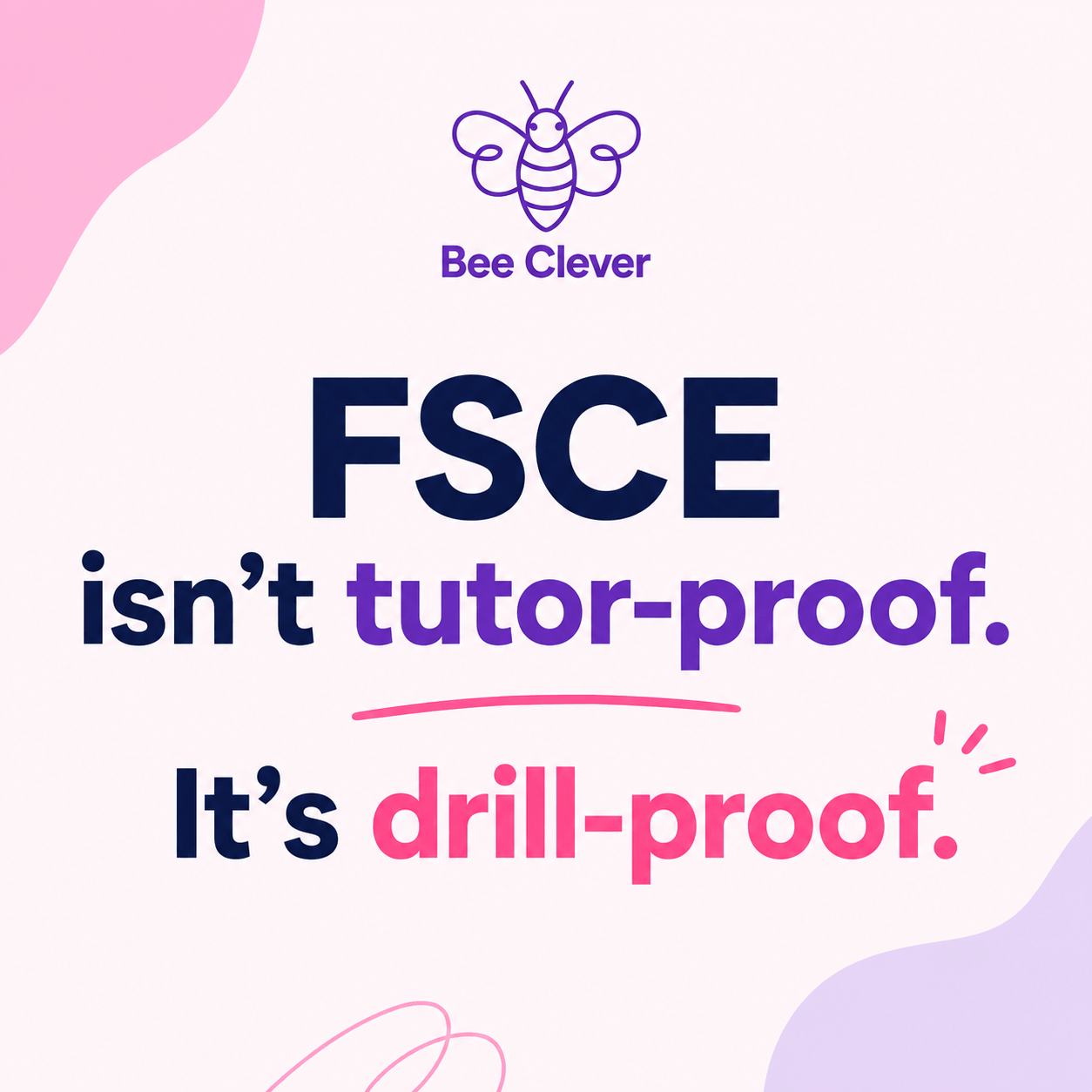
FSCE Is Not Tutor-Proof. It Is Drill-Proof.
Children who have simply memorised dozens of question types may find the
new assessments more challenging.
Children who have developed secure literacy, numeracy and reasoning
skills should continue to thrive.
That is an important distinction.
Good tutoring has never been about teaching children
what will come up.
It is about ensuring they have the knowledge, confidence and thinking
skills to succeed whatever comes up.
Imagine two children sitting the same comprehension paper.
One has memorised twenty comprehension “techniques”.
The other has spent a year reading challenging texts, expanding their
vocabulary, discussing inference and writing regularly.
When the exam presents an unfamiliar passage, which child is more likely
to succeed?
That is the distinction FSCE appears to be making.
What Do the FSCE Familiarisation Materials Tell Us?
One of the clearest indications of the direction FSCE is taking comes
from its own published familiarisation materials.
Rather than offering up lots of discrete verbal or non-verbal
reasoning question types, the sample materials place a strong emphasis
on vocabulary in context, reading comprehension, spelling, grammar and
mathematical reasoning through worded problems.
These are not new tutor-proof exam skills.
They are the foundations of strong literacy and numeracy.
In other words, the familiarisation materials appear to reward the
abilities children develop over months and years—not techniques that can
simply be memorised during the final weeks before an exam.
Parents can therefore expect the assessments to place considerable
emphasis on:
- reading comprehension;
- vocabulary in context;
- grammar and punctuation;
- accurate spelling;
- mathematical reasoning;
- creative writing; and
- applying knowledge in unfamiliar situations.
These are precisely the skills children need not only to gain entry to
grammar school, but to flourish once they get there.
What Does This Mean for 11+ Tuition?
For tuition providers whose programmes relied heavily on drilling
specific question types, FSCE may require a significant change in
approach.
For providers whose focus has always been on developing strong readers,
confident writers and capable mathematicians, the transition is likely
to feel far more natural.
High-quality tuition has never been about shortcuts.
It has always been about helping children acquire knowledge, develop
confidence and think more effectively.
Why We Welcome the Move to FSCE
Long before the move to FSCE was announced, the Bee Clever curriculum was built
around ambitious vocabulary, challenging reading comprehension,
mathematical reasoning, creative writing, grammar, retrieval practice
and problem-solving.
Over the past year, we have expanded those areas even further—not
because we anticipated a particular exam board, but because we believe
they are the foundations of genuine academic success.
FSCE has not changed what we believe children need to succeed.It has simply reinforced it.
We teach children how to approach entrance examinations confidently and
manage their time effectively.
Strong literacy and numeracy have always been the foundations of our
curriculum.
Whether a child eventually sits an FSCE assessment or another selective
entrance examination, those skills remain invaluable.
Looking Beyond One Exam Board
Exam boards change.
Question styles evolve.
Admissions policies are updated.
Strong literacy and numeracy remain valuable regardless.
The children who perform best are usually those with secure foundations,
broad vocabulary, excellent reading skills and confident mathematical
thinking.
Those qualities cannot be memorised.
They are built over time through excellent teaching, consistent practice
and thoughtful feedback.
Bee Clever and the Future of the 11+
Perhaps that is why we think the phrase
“tutor-proof” misses the point.
The purpose of excellent tuition has never been to teach children
yesterday’s questions.
It has always been to prepare them for tomorrow’s.
Exams will continue to evolve.
Strong readers will always understand more.
Strong writers will always communicate more clearly.
Strong mathematicians will always solve unfamiliar problems more
effectively.
Those are the skills Bee Clever has always taught.
We believe they will remain the skills that matter long after today’s
exam board has been replaced by tomorrow’s.
Rather than asking whether an exam is “tutor-proof”, perhaps the better
question is:
Would you rather prepare your child for one exam—or equip them with
the skills to succeed in every exam?